
When The Boss Changes: A Survival Guide For Internal Comms
There's a lot of talk at the moment about who's going to be running the country next. Whatever your politics, a change at the very top is a useful prompt for the rest of us who work in organisations, because every business goes through it too. One day the person in the big chair leaves and someone new sits down.
When it happens to a country, we all watch it play out on the news. When it happens to a business, it lands on the internal comms person's desk with very little warning and a lot of anxious people wanting to know what it means for them.
I've been closely involved in one high-profile change of CEO, plus a few other changes at the very top. No two are the same. But the way you communicate makes an enormous difference to how settled people feel on the other side of it. So, here's how I think about it.
It’s never just “we have a new CEO”
The instinct is to treat a leadership change as a single announcement. New name, nice photo, a few warm words, job done. It isn't.
How you communicate depends entirely on the kind of change it is. A planned, long-signalled handover needs a very different touch from a CEO whose departure is announced with no warning.
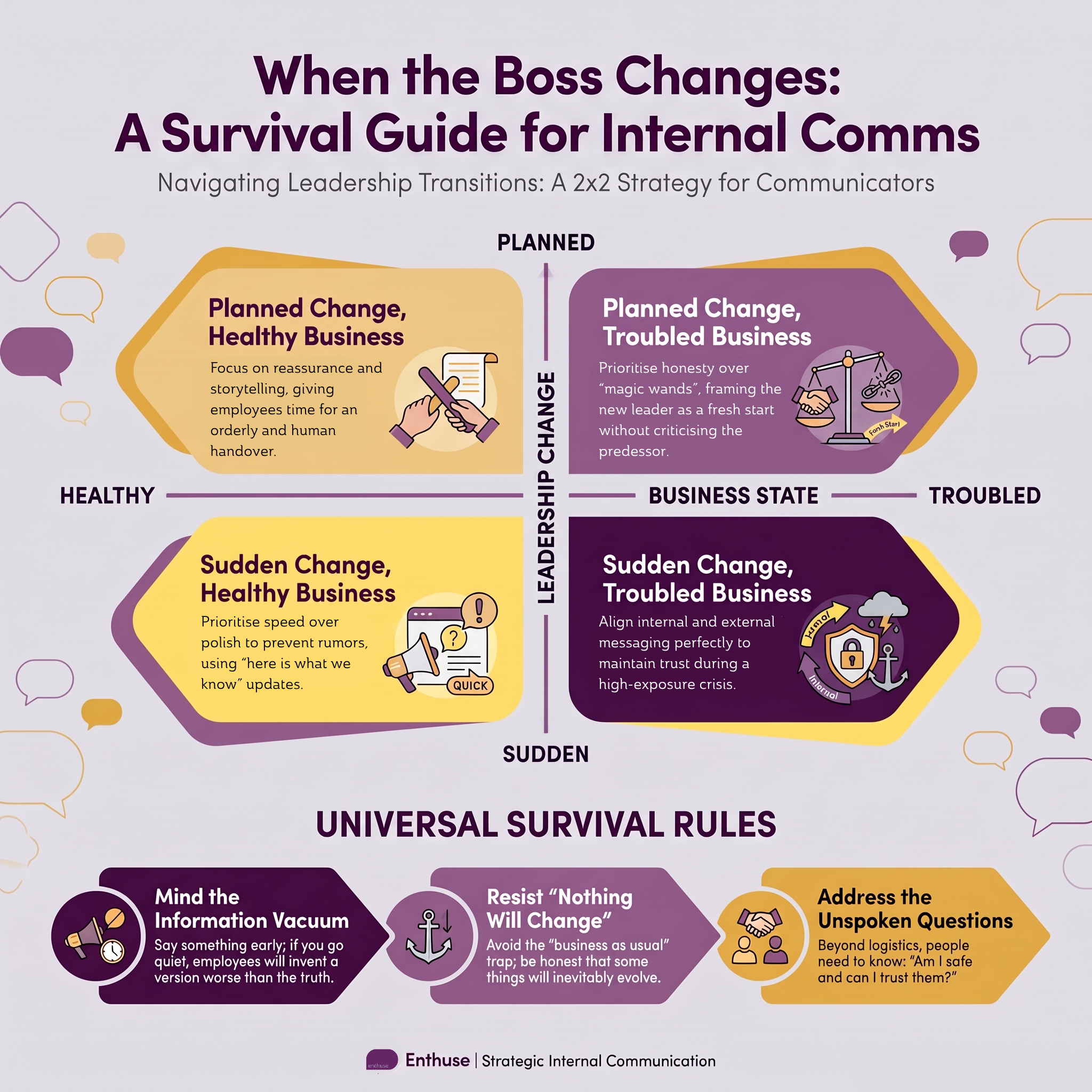
So, before you write a word, work out which situation you're actually in. Most leadership changes sit somewhere on two simple questions.
Was it planned or sudden?
Is the new leader inheriting a healthy business or a troubled one?
Those two questions give you four very different starting points.
The four scenarios
Planned change, healthy business
The dream. A succession plan, an orderly handover, a business in good shape. You see this often in family firms and well-run organisations that think ahead.
Your job here is mostly reassurance and storytelling. Give people time to say goodbye to the outgoing leader properly. Introduce the new one as a person, not a press release. Be clear about what stays the same, because continuity is the message people most want to hear. You have the luxury of pace, so use it.
Planned change, troubled business

The handover is orderly, but the new leader is stepping into a mess. Perhaps the last one was moved on because things weren't working.
Honesty is everything here. People already know things aren't right, so pretending otherwise insults them. Acknowledge the challenges plainly, then frame the new leader as a fresh start rather than a magic wand. Be careful not to criticise the predecessor while you do it. People who liked the old boss will bristle and it makes the business look graceless and tone deaf.
Sudden change, healthy business
A shock, but not a scandal. Often this is health-related, a personal crisis, or simply an unexpected resignation. The business itself is fine and in good shape.
Speed matters more than polish. The gap between "something has happened" and "here's what it means" is where rumours breed, so move quickly even if you can't say everything yet. "Here's what we know, here's what we don't, here's when we'll update you" is a perfectly good first message. If it's a health or personal matter, protect the individual's privacy and dignity and say only what you've been given permission to say.
Sudden change, troubled business
The hardest one. A crisis, a reputational issue, a leader asked to step down in a hurry. The external world is watching and your phone is ringing.
This is where internal and external comms have to move as one. Let the PR and media relations team handle the outside world, but make sure your internal message matches it word for word, because nothing erodes trust faster than employees hearing one story from the company and another from the news. People inside will feel exposed and embarrassed, so give them the facts, give them a line they can use if customers ask and give them somewhere to take their questions.
The things that cut across all four
Once you know which scenario you're in, a few principles apply whatever the situation.
Mind the gap between announcement and explanation
This is the big one. The single most common mistake in any leadership change is announcing the news and then going quiet while the detail gets "finalised". People cannot bear an information vacuum. They fill it themselves and the version they invent is almost always worse than the truth. If you take one thing from this, take this: say something early, even if it's only to say when you'll say more.
Internal hire or external hire changes the job
Promoting someone from within sends a lovely signal about opportunity but spare a thought for the colleagues who wanted that role and didn't get it. Bringing in an outsider brings energy and fresh eyes, but also a wave of "what does this mean for how we do things". Name the thing people are worried about and you take the heat out of it.

Watch for the much-loved leaver
A leadership change can be entirely orderly, entirely healthy, planned to the day and still knock morale sideways if the person leaving was adored. That's an emotional situation and no amount of clear process communication can fix a sad goodbye. Give people room to feel.
Resist "nothing will change"
New leaders love to reassure with "it's business as usual". People rarely believe it and it boxes the leader in the moment anything does change. Far better to be honest. Some things will stay the same, some things will evolve and we'll tell you as we go.
Don't forget the interim
If there's a caretaker holding the fort before a permanent appointment, be crystal clear about who is actually in charge and for how long. An unexplained gap at the top is rumour fuel of the highest order.
The real point
A change of leader is one of the most unsettling things a workforce goes through and it's almost always handled as a logistics exercise when it's really an emotional one. People aren't only asking "who's in charge now". They're asking, "am I safe, will my job change, do they understand what we do and can I trust them".
Good internal comms answers the spoken questions and the unspoken ones. It does it quickly, it does it honestly and it does it with a bit of humanity. Do that, and a change at the top becomes something your people move through together rather than something that happens to them.
If your organisation is heading into a leadership change, or you'd just like to be ready for the day it comes, that's exactly the sort of thing we help with. Drop me a message and we'll have a chat.
andrea.law@enthuse-comms.co.uk.